4 August
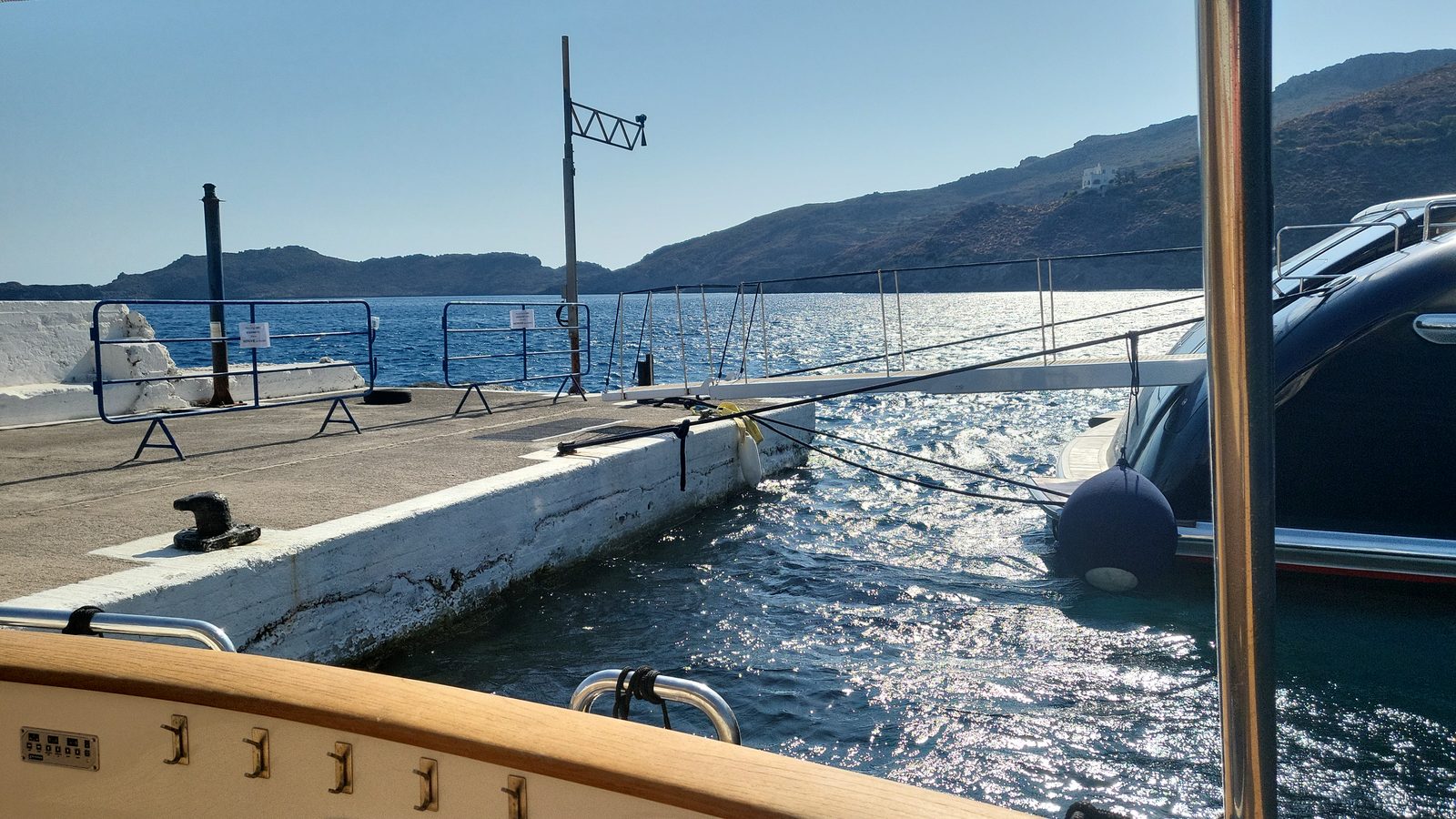
Super yacht mooring astern
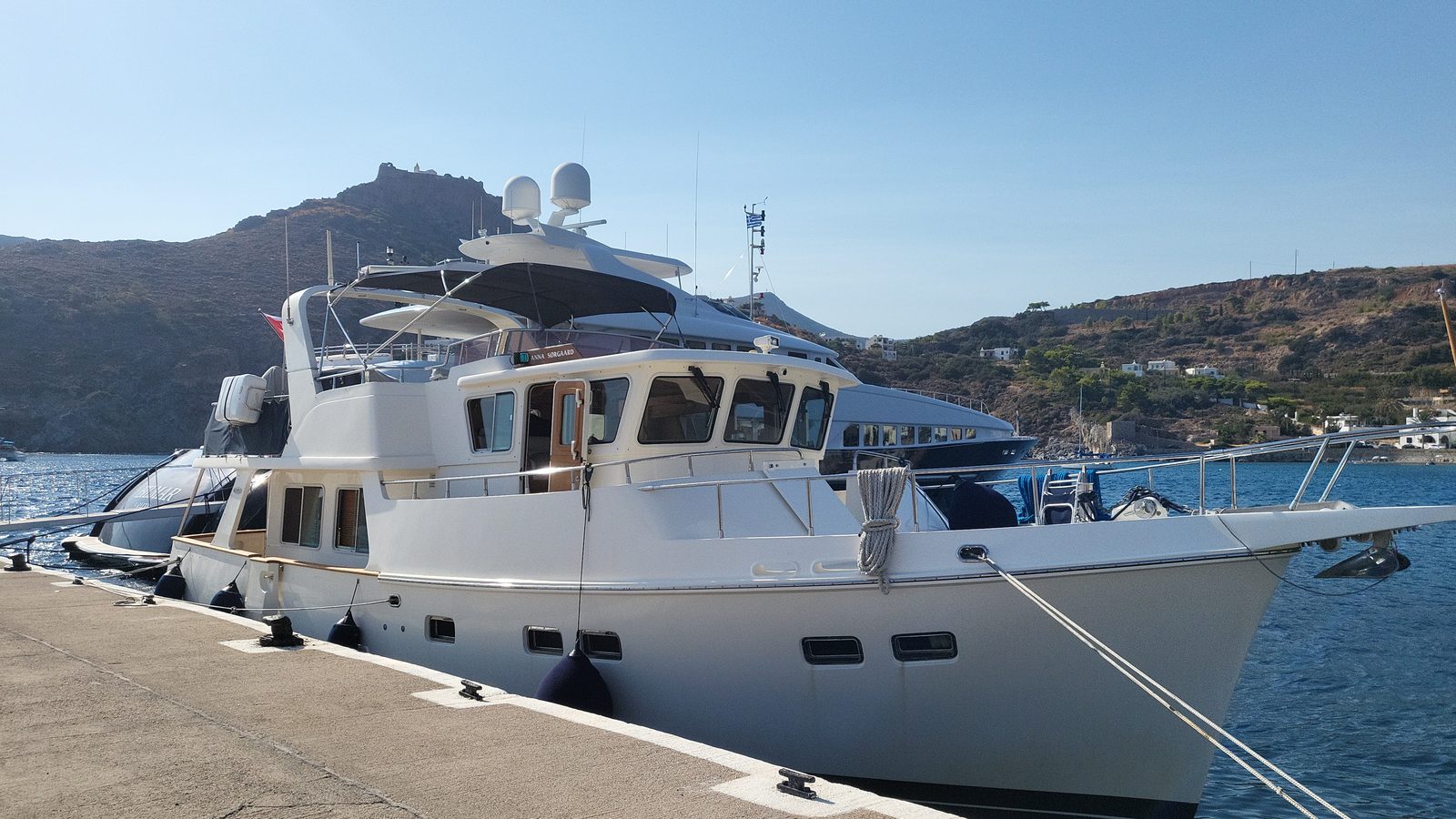
Anna with super yacht behind
“When it rains, it pours” was a successful marketing slogan for the Morton Salt Company, used when they added magnesium carbonate to their salt to prevent it from clumping in humid weather. Today, we use this phrase to mean that problems often come all at once.
The Salt poured freely on the first day of my solo voyage. I left Agio Nicholaos around 0630 for a 23-hour trip to Kythera, with the option of stopping in Chania to break the trip into two 12-hour legs. Those who know me well would bet that I didn’t stop, and they would be right. The weather was okay, and I wanted to cross the water gap between Crete and Kythera, which is just off the Peloponnesian peninsula. The Meltimi can be fierce, and I wanted to be on the other side before it picked up.
However, the weather turned gusty, and the waves, while not more than 1m high, came at a three-second frequency, making the sea very choppy. The mixed winds made it hard to maintain the preferred 80-degree angle, so I was constantly adjusting. The thought of a nice overnight voyage quickly evaporated.
I finally reached Kythera at 0505. It was still dark, so I waited until pre-sunrise for enough light to find a suitable anchorage. Despite six boats in the bay, I found room and dropped anchor, using the windlass to release the chain into the 10-meter (33 ft) deep water. When I tried to adjust the rode (the length of chain/line from the boat to the anchor), the windlass barely worked. Despite just using it, it only functioned for about 10 chain links before stopping. The electric motor seemed to be binding, or it wasn’t getting enough power from the house battery bank, which was fully charged after 22 hours of engine operation, as confirmed by the Victron app on my phone. The motor was kaput!
With 100 meters of 13mm chain weighing about 380kg (836lbs) in the locker, I still had 10m of chain in the water. I had to bring it in mostly by hand. The windlass helped intermittently for 10 seconds, but I had to pull and rest repeatedly until the 10m of chain and the 35kg anchor were on board. Luckily, I wasn’t too close to other boats because once the anchor was off the seabed, boats start to drift. This is even riskier when solo. But the anchor was up, the windlass was dead, and I needed to find a marina, which I knew didn’t exist on the island.
There was a small pier next to the bay with eight sailboats moored astern. I moved Anna over and carefully secured her along the starboard side. A kind older man helped me manage the lines, but there were two prominent signs saying “You cannot moor here, please REMOVE your boat.” I ignored them and went to work on the windlass. After cleaning the electric terminals and solenoid switch, it still didn’t respond. I checked the batteries and removed the chain gypsies to ensure they weren’t causing the bind. Nothing worked, so I officially declared the windlass dead.
In problem-solving mode, I became laser-focused. I called Mikel to explain the issues and that I would need her help booking back-to-back marinas for the return to Barcelona, as I couldn’t anchor out. I said I’d call back but needed a shower and some sleep before someone told me to leave.
After a few hours of sleep, I called Mikel, and we spent an hour planning the voyage. She would confirm reservations I made via the Navily app. Just then, someone from the pier asked why I was moored there, and I quickly saw that a 200-foot super yacht was trying to moor astern. That’s why the signs were there.
I explained my plight, and they helped me move forward a bit, securing three-quarters of the super yacht’s swim platform. Thankfully, they didn’t kick me out! I relaxed slightly, knowing I wouldn’t be asked to move. Mikel called back with 90% of the marina confirmations, so everything looked good.
I decided to have dinner at one of the bay’s restaurants, finishing around 20:00. When I returned to Anna, the sailboat in front had lost its bow anchor. Due to high winds, it was angling toward Anna and would certainly hit her once the anchor was fully free.
I took some line and a ball fender (a bumper) and secured the boat, partly to prevent it from hitting Anna. Other people on the pier helped, but the wind was so strong that it was hard to right the boat. Eventually, I managed to secure a line to hold it until the owner arrived. The wind picked up, so I added another line. A lady on the pier offered to find the captain. She noted the boat’s name and made announcements at all six restaurants. Fifteen minutes later, the captain, his mate, and their two wives arrived. They started the engine, righted the boat, and reset the anchor. I took the slack from the line I had set and secured it to the pier bollard. The ball fender worked, but the boat’s back got scratched. They were secure, and I was exhausted.
I asked if they would move their boat the next morning so I could get out, as I was pinned between two sailboats. During dinner, another sailboat had tied up between Anna’s stern and the super yacht. The next morning, they returned my line and fender and moved out. The wind was blowing against Anna’s port side, making it difficult to maneuver, so I overworked the bow thruster to gain space to pull out.
I was finally on my way. The marinas were secured, the weather and seas were calm, and I plotted the course to Zakynthos, a 24-hour trip. I set Anna’s autopilot to “track” the route and went down to get a coffee. When I checked the stern, I saw a large dark blue ball floating in the water. It was the ball fender that had been returned. I had put it on the bow but didn’t secure it, and it had bounced off into the sea.
“MOB” are important initials for captains, meaning “Man Over Board.” There are several techniques to steer a yacht in a MOB situation: the Figure-8 Turn, the Anderson Turn, the Williamson Turn, and the Scharnow Turn. In getting my Merchant Marine Credentials, I learned all these but never practiced them. Now was my chance.
The ball fender was my MOB, and I started the Figure 8 turn to retrieve it on my port side. I was three meters too far away on the first attempt, but on the second try, I kept the MOB straight in my approach and was ready to rescue it on either side, aiming for the port side again. I succeeded, snagging the fender line with my 1.5m hook. It was safe.
Sitting in the pilothouse writing this tome of Solo Voyage – Day 1, all systems are go. In less than 24 hours, I will be in Zakynthos. Hopefully, Solo Voyage – Day 2 will be more succinct.
Comments
From the old site. Comments are closed; write to us through the contact page.
Mikel Ann Braaten, 5 August 2024
Wow! Well done on the MOB maneuver!!!!
Christian Theis, 5 August 2024
What an adventure!
wishing you a safe solo trip
Take good care
Christian
Robert Glanville, 5 August 2024
Keep us in the loop, DB… any plans to be on the west coast of Portugal Aug 24-Sept 4? we are hiking the Camino from Porto to Santiago de Compostela